
Genetics
- Inheritance
- Incomplete dominant
- Locus
- PAX7 (associated)
One Mack allele produces Mack Snow; two copies of the same allele produce Mack Super Snow. These are two expressions of one locus. The inheritance term used here is incomplete dominance.
Established Ullate-Agote & Tzika (2024)
Researchers associated the studied Mack Snow allele with a deletion affecting PAX7, a gene involved in pigment cell development.
Established Ullate-Agote & Tzika (2024)
One copy · Mack Snow
One copy is visible, so a Mack Snow is not a visually normal recessive carrier.
Established Ullate-Agote & Tzika (2024)
Two copies · Mack Super Snow
Mack Super Snow is homozygous for the Mack variant. The study documented adults, so the two-copy genotype is viable; that observation does not establish that all individuals are free of health concerns.
Established Ullate-Agote & Tzika (2024)
Appearance
A one-copy hatchling typically has pale bands where a wild-type hatchling has yellow. Yellow can become more visible with age, which can make adult identification harder.
Established Ullate-Agote & Tzika (2024)
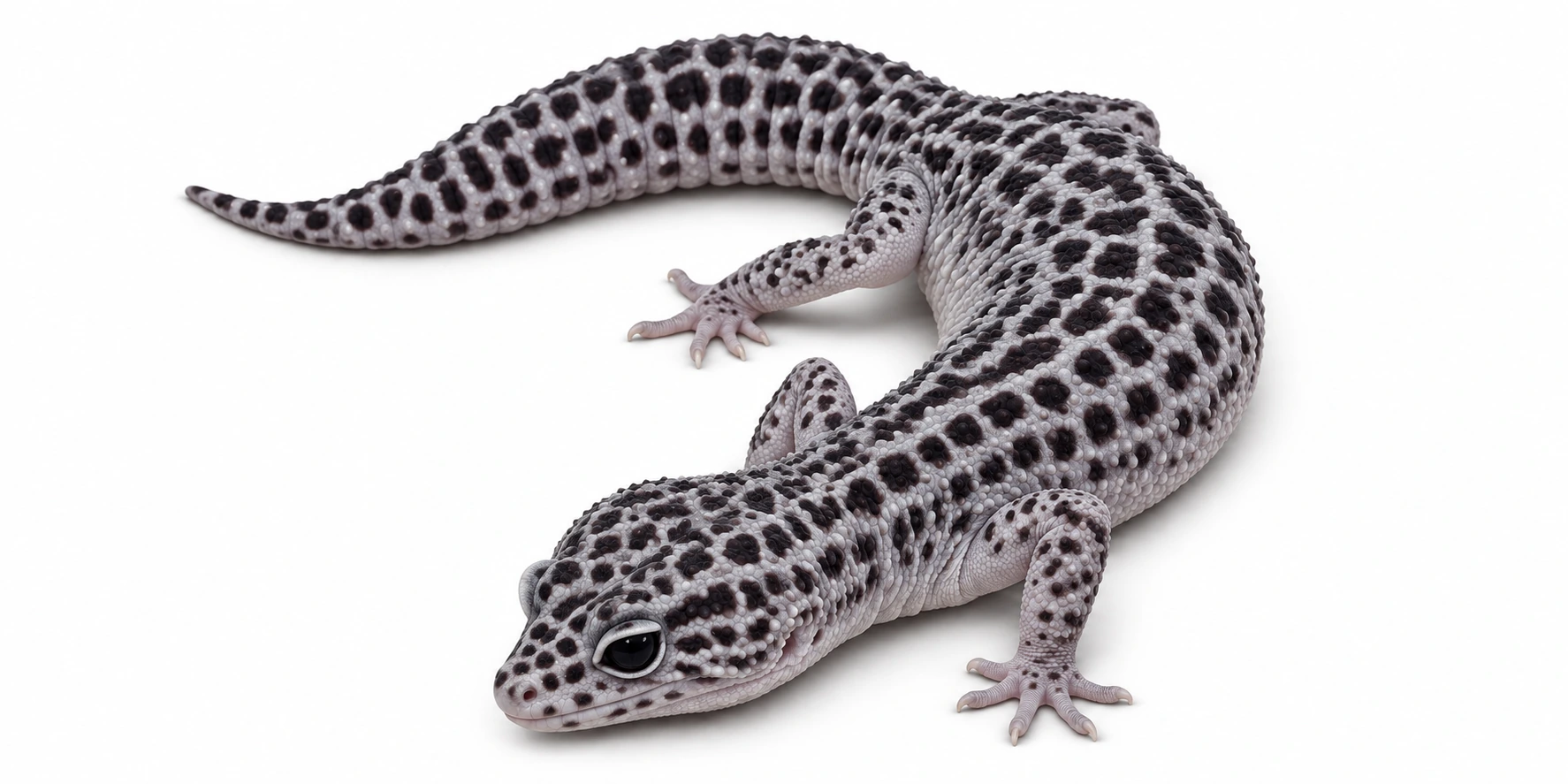
Dark hatchlings develop black spotting against a light background as adults. The study also shows dark eyes. Other traits can modify the appearance.
Established Ullate-Agote & Tzika (2024)
Related morphs
Sources & references
- The dynamic behavior of chromatophores marks the transition from bands to spots in leopard geckosUllate-Agote & Tzika (2024) · Peer-reviewed study · Checked